
R. Viconde de Pirajá, 414 - Ipanema
Rio de Janeiro - Brazil
9:00AM to 7:00 PM
Moday To Friday
+55 21 976 723 023
R. Viconde de Pirajá, 414 - Ipanema
Rio de Janeiro - Brazil
9:00AM to 7:00 PM
Moday To Friday
+55 21 976 723 023
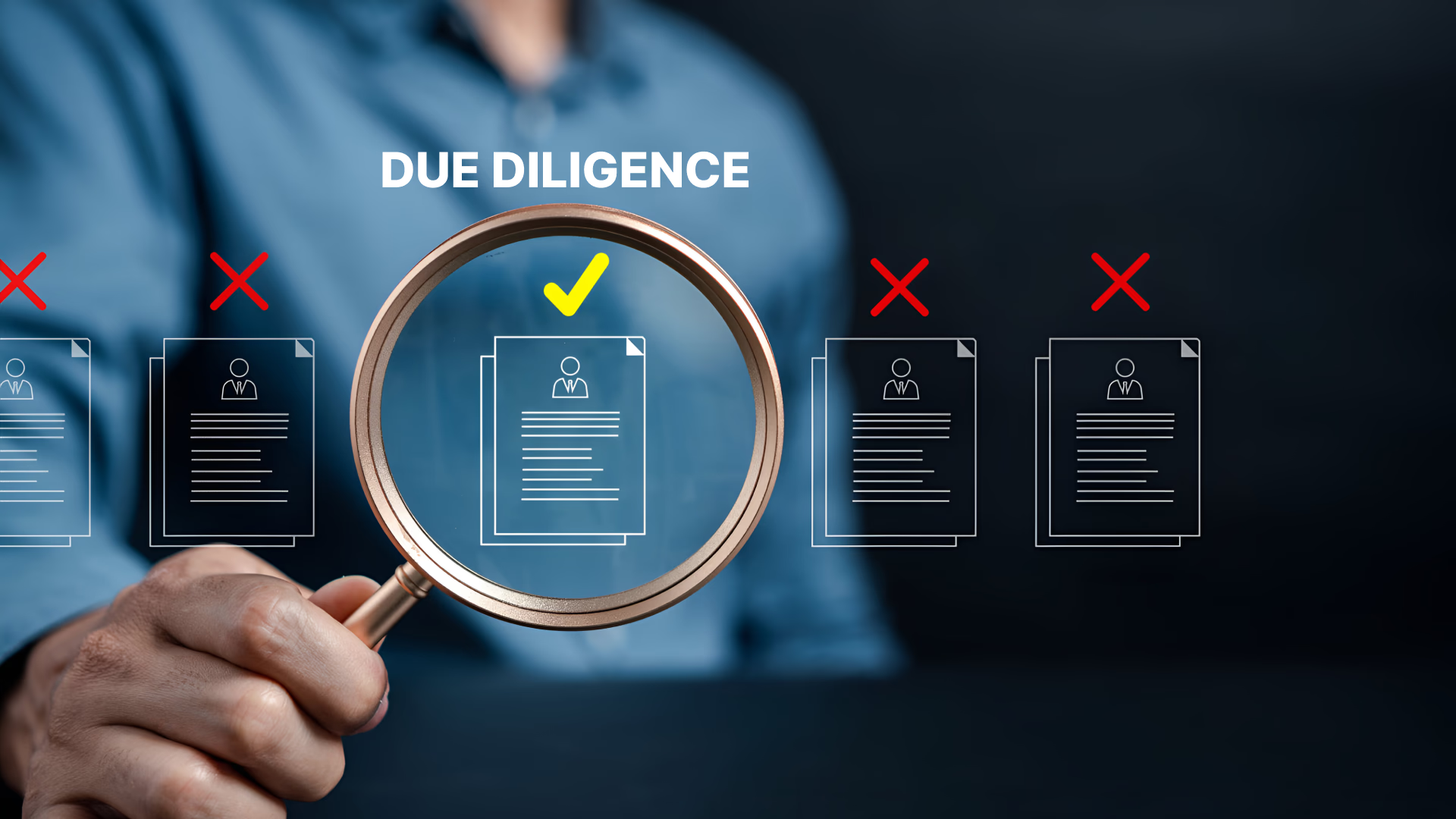
Buy frozen beef wholesale – How do you verify a Brazilian meat supplier before sending money?
To verify a Brazilian meat supplier, check the company’s legal identity and CNPJ, SIF and establishment information, eligibility for your destination market, exact product, certifications, representative, corporate email domain, commercial documents and beneficiary bank account. Never rely on a website, quotation, WhatsApp conversation or document supplied by the seller as your only source of verification.
That distinction matters because finding a Brazilian meat supplier and verifying a Brazilian meat supplier are two different processes. A company can exist, its website can be real and its SIF information can be real — and that still does not automatically prove that every person, product, bank account or commercial offer presented under that company’s name is legitimate or appropriate for your transaction.
If you are preparing to import Brazilian beef, frozen chicken or pork, this guide explains what should be investigated before you move forward with a supplier.
Contents
Most international buyers begin in the same place. They search for terms such as Brazilian meat suppliers, Brazilian beef exporters, Brazil frozen chicken suppliers, Brazilian pork exporters or meat suppliers in Brazil. They find companies, visit websites, exchange emails or WhatsApp messages and request quotations.
That is useful for supplier discovery. It is not complete supplier verification.
The real question is not simply, “Does this company exist?” A professional buyer should also be asking: Who am I actually negotiating with? Does the establishment handle the product being offered? Can the establishment serve my destination under the applicable requirements? Do the commercial documents match the company? Does the bank beneficiary make sense? Does the transaction itself make commercial and logistical sense?
That is where professional due diligence begins.
Buying chicken meat wholesale can be very dangerous if you do not verify the exporter’s credentials—such as SIF, CNPJ, etc.
Start with the legal entity behind the commercial offer. Ask for the company’s full legal name and CNPJ — Cadastro Nacional da Pessoa Jurídica, the Brazilian corporate taxpayer registration number.
Then compare that information with the other elements of the transaction. Check whether the company name appearing on the quotation, Proforma Invoice, contract and banking information is consistent. Do not assume that a commercial brand and the legal entity receiving payment are necessarily the same.
If different companies appear during the transaction, ask why. There may be a legitimate commercial explanation, but you should understand that explanation before payment, not afterward.
The objective is consistency.

Buy beef from Brazilian slaughterhouses, but before making any payment, download the Brazilian beef exporters directory.
If you import Brazilian meat, you will frequently encounter the acronym SIF, which means Serviço de Inspeção Federal, or Federal Inspection Service.
For establishments dealing with products of animal origin in interstate or international commerce, federal inspection is an important part of Brazil’s sanitary control structure. But importers need to understand an important distinction: a SIF reference should not be treated as complete supplier due diligence.
It answers an important regulatory question about the establishment, but it does not independently prove every other element of your commercial transaction. You still need to investigate the company, product, destination requirements, representative, documents and payment instructions.
This is one of the most important points for international buyers. A Brazilian establishment being registered does not mean that every product can automatically be shipped to every country.
Destination-market requirements matter. Depending on the importing country, establishments may need additional authorization or habilitação. Requirements can also differ according to product and market.
Therefore, instead of asking only “Does this supplier have SIF?”, ask:
“Is the relevant establishment eligible to supply this product to my destination under the applicable requirements?”
That is a much stronger procurement question.
A legitimate company does not automatically validate every product offer made in its name. Confirm exactly what you are buying.
For beef, chicken and pork transactions, relevant commercial specifications may include:
Then investigate whether the establishment involved actually handles that product. A supplier being legitimate is not enough if the specific supply being offered cannot be substantiated.
For buyers serving Muslim markets, Halal requirements may be commercially and legally important. Do not simply accept the word “Halal” printed on a quotation.
Verify the certification relevant to the transaction and determine whether it applies to the establishment and product involved. The same principle applies to other certifications requested by your company or destination market.
Ask who issued the certification, whether it is current, what establishment it covers, what products or activities are within its scope, and whether it satisfies your market’s requirements. Certification verification should be part of supplier due diligence, not an afterthought.

Knowing just the price of chicken meat per ton isn’t enough. You need to verify that you aren’t dealing with a scammer posing as a major, established chicken exporter.
This is where many buyers can become vulnerable. Imagine that you find the name of a real Brazilian exporter. Someone contacts you claiming to represent that company, uses the company’s logo, knows its address, sends photographs of its products and provides professional-looking documents.
The company itself may be completely legitimate. But you still need to answer another question:
Does this person actually represent the company?
Whenever possible, independently confirm the commercial representative through an official company channel. Do not use only the contact information supplied by the person whose identity you are trying to verify.
Look at the sender’s email address, not just the sender’s name. The domain matters.
Fraud can involve domains that visually resemble legitimate company domains. Look for misspellings, additional characters, different domain extensions, free email services, recently introduced domains and differences between website and email domains.
A professional email address alone does not prove legitimacy, but inconsistencies are reasons to investigate further.
Professional-looking PDFs are not independent verification. Compare information across the Quotation, Proforma Invoice, Contract, Packing information, Certificates, Company registration information and Banking instructions.
Look for inconsistencies in company names, addresses, CNPJ, email domains, telephone numbers, bank beneficiary, product specifications, Incoterms, ports and payment terms.
Small inconsistencies may have innocent explanations. They may also expose something important. The point is not to assume fraud; the point is to investigate discrepancies before sending money.
Bank-account verification deserves its own step. Do not assume banking information is legitimate simply because it appears on a professional Proforma Invoice.
Confirm who the beneficiary is, whether the beneficiary corresponds to the commercial counterparty, why payment is being requested to that entity and whether the bank account has changed during the negotiation.
A last-minute change in payment instructions deserves particular attention. If banking information changes, independently reconfirm the new instructions through a trusted company channel.
Never allow urgency to replace verification.
A low price does not automatically mean fraud, but an unusually attractive offer should produce more due diligence, not less.
Consider the entire transaction: product, specification, origin, quantity, Incoterm, freight, destination, payment structure, availability and shipment window.
Professional procurement is not about finding the lowest number in your inbox. It is about understanding whether the entire transaction makes sense. If an offer appears dramatically better than alternatives, determine why.
Before signing or paying, understand precisely how much is paid, when it is paid, to whom, against which document or event, through which bank, what happens before shipment and what happens after shipment.
Avoid entering transactions where payment procedures remain unclear. Ambiguity before payment rarely becomes easier after payment.
Commercial fraud is not the only risk in meat sourcing. A transaction can also fail because the logistics never made sense.
Check the port of loading, port of destination, Incoterm, reefer/container requirements, cold-chain responsibilities, loading schedule, documentation sequence, inspection arrangements where applicable and transit assumptions.
The commercial offer and the physical movement of the product should tell the same story.
International commodity markets attract many intermediaries. Some may have legitimate commercial relationships; others may simply be circulating offers.
If someone claims direct access to a Brazilian meat exporter, ask what the company’s role is, who will issue the commercial documents, who owns or controls the supply, who receives payment and whether the commercial relationship can be independently substantiated.
Do not confuse access to a PDF quotation with access to physical supply.
This distinction deserves special attention. Many importers understand the concept of a fake supplier: the company does not exist. But there are other scenarios that require just as much attention.
The exporter exists, but the person contacting you is not authorized.
The commercial identity may be legitimate while payment instructions have been manipulated.
The company exists but cannot substantiate the particular product being offered.
The establishment exists but may not satisfy the requirements applicable to that product and importing market.
Authentic-looking commercial material can be copied or modified.
This is why supplier verification should examine the entire transaction, not only the company name.

Statements such as “You must pay today,” “The allocation will disappear in two hours,” “Do not contact the exporter directly,” or “There is no time to verify the bank account” should make a buyer more careful.
International trade can certainly involve deadlines and rapidly changing availability. But legitimate commercial urgency does not eliminate the need for verification.
If someone is actively discouraging independent verification, understand why before proceeding.
One of the simplest principles of due diligence is:
Do not verify information only with the person who supplied the information.
If the seller provides a company number, independently check the company. If the seller provides establishment information, investigate the relevant official records. If the seller provides certification, independently investigate it where possible.
If someone claims to represent a company, confirm through another company channel. If payment instructions change, independently reconfirm them.
Supplier verification becomes stronger when information from different independent sources tells the same story.
Before authorizing payment, ask yourself:
If an important answer is still “I don’t know,” you have identified what requires additional verification.
If you are currently evaluating a Brazilian beef, frozen chicken or pork supplier, you do not need to remember every verification step yourself.
Mello Commodity created the Brazilian Meat Supplier Due Diligence Checklist to organize the process into 17 practical checks before payment.
The checklist includes:
✓ Company and CNPJ verification
✓ SIF and establishment checks
✓ Destination eligibility
✓ Product verification
✓ Certification checks
✓ Representative verification
✓ Email and domain review
✓ Commercial-document verification
✓ Banking checks
✓ Payment and shipment logic
✓ Fraud red flags
✓ 5-Minute Supplier Test
✓ Supplier Review Worksheet
Get the Brazilian Meat Supplier Due Diligence Checklist — US$7.90
Brazil’s Ministry of Agriculture and Livestock — MAPA — maintains official information related to the Serviço de Inspeção Federal (SIF) and establishments involved with products of animal origin.
For international trade, MAPA explains that establishments operating in interstate or international commerce are subject to federal inspection. It also makes clear that, beyond registration, establishments must meet the sanitary requirements applicable to importing countries or blocs.
For some destinations, registration alone is not sufficient: additional export authorization or habilitação may be required. Professional importers should therefore investigate both the establishment and the requirements applicable to the specific destination and product.
Use official regulatory sources as part of your verification process rather than relying exclusively on documents or screenshots supplied during the negotiation.
Verify the company’s legal identity and CNPJ, SIF/establishment information, product, destination-market requirements, certifications, representative, corporate email domain, commercial documents and beneficiary bank account. Cross-check important information using independent sources before payment.
Start with the legal company and establishment, but do not stop there. Verify who is representing the company, what product is being offered, whether relevant destination requirements are met, which entity receives payment and whether the overall transaction is commercially consistent.
SIF stands for Serviço de Inspeção Federal, Brazil’s Federal Inspection Service for products of animal origin. Establishments involved in interstate or international commerce fall under federal inspection requirements.
No. Destination requirements differ. Some importing countries require specific establishment authorization in addition to Brazilian registration, and the relevant product must also fall within the applicable authorization and sanitary requirements.
Consult the applicable official Brazilian export authorization information for your destination and verify any requirements imposed by your own country’s competent authority. Eligibility should be checked for the relevant establishment, product and destination.
Do not rely on a website, WhatsApp conversation, quotation or certificate alone. Independently verify the legal company, establishment, representative, email domain, documents, bank beneficiary and transaction logic.
No. A commercial document is part of a transaction, not independent proof of the identity or authority of the party sending it. Cross-check its information against independent sources.
Yes. Independently confirm the beneficiary and payment instructions, particularly if banking information changes during the negotiation.

Due diligence solves one part of the sourcing problem. The next question is: Which Brazilian meat suppliers should your company investigate?
The Brazilian Meat Suppliers Guide 2026 provides professional buyers with an organized starting point for researching Brazilian meat suppliers.
It includes:
The Guide does not replace independent due diligence. It gives you a larger, structured pool of companies to research and evaluate.
1. Learn what to verify.
Get the Brazilian Meat Supplier Due Diligence Checklist — US$7.90
See how to conduct due diligence here.
2. Find more suppliers to evaluate.
Explore the Brazilian Meat Suppliers Guide 2026 — US$29.90

Finding suppliers is not the difficult part of international sourcing anymore. Search engines, directories, marketplaces and social networks can produce hundreds of company names.
The difficult part is determining which information deserves your trust before your company commits money. Treat supplier discovery and supplier verification as separate processes: find companies, verify independently, compare evidence, resolve inconsistencies and confirm payment instructions. Then decide whether the transaction deserves to move forward.
Before you send money to a Brazilian meat supplier, know what you have verified — and what you have not.
17 checks before payment.
US$7.90 — Instant Digital Access

Brazilian, graduated in Marketing, Specialist in Service Management and Strategic Communication.
Important International Negotiator in the commercialization of Brazilian agricultural commodities such as: Sugar, Soybeans and Corn.
Owner of Mello Commdity, she has gained great prominence on the internet in recent years by promoting educational articles for importers of Brazilian agricultural commodities.
 VHP Sugar Wholesale Suppliers in Brazil: What Refinery Buyers Should Confirm Before Buying
 Scam Alert – A Real Brazilian Sugar Factory Can Appear in a Fake Offer
 Brazil Wood Pellet Exporters: Why International Buyers Are Moving Earlier to Secure Brazilian Supply
 Brazil Sugar Suppliers: How Regular Importers Can Source ICUMSA 45, ICUMSA 150 and VHP Sugar from Brazil
1 thought on “How to Verify a Brazilian Meat Supplier: Complete Guide for Importers”